Search result for "New Plymouth ".
-
 Call for International Students' Fee RefundsVictoria University of Wellington should reimburse 30% of International Students' fees for Trimester 1 (and Trimester 2 if teaching is being delivered online), as long as International Students cannot physically utilise the University's facilities. Additionally, this must be done in a way to also minimise job losses within the University.1,101 of 2,000 SignaturesCreated by V-ISA, VUW International Students' Association
-
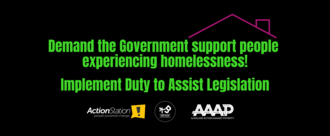.png) Demand the Government support people experiencing homelessness!We are calling on the Government to work across the house to develop and implement Duty to Assist legislation. This would place responsibility on government agencies to prevent homelessness, provide support to those experiencing homelessness, and support people into secure and permanent housing. This legislation would also place responsibility on health professionals and other government agencies (such as schools, hospitals, organisations serving people who are at-risk of homelessness) to refer whānau who are at-risk of homelessness to the appropriate government agency. Such legislation has been successful internationally and would be an important step towards addressing the structural challenges contributing to homelessness within Aotearoa.7,194 of 8,000 SignaturesCreated by Kick Back
Demand the Government support people experiencing homelessness!We are calling on the Government to work across the house to develop and implement Duty to Assist legislation. This would place responsibility on government agencies to prevent homelessness, provide support to those experiencing homelessness, and support people into secure and permanent housing. This legislation would also place responsibility on health professionals and other government agencies (such as schools, hospitals, organisations serving people who are at-risk of homelessness) to refer whānau who are at-risk of homelessness to the appropriate government agency. Such legislation has been successful internationally and would be an important step towards addressing the structural challenges contributing to homelessness within Aotearoa.7,194 of 8,000 SignaturesCreated by Kick Back -
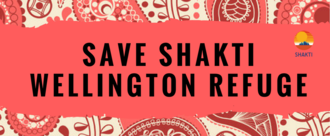 Save Shakti Wellington RefugeWe the undersigned demand the Ministry of Social Development adequately funds Shakti Wellington Refuge to support migrant and refugee women experiencing family violence in the greater Wellington region. Last year, Shakti was contracted by Ministry of Social Development to conduct a needs analysis and the resulting evidence pointed to a need for specialist refuge services for migrant and refugee women needing intervention and support from family violence. Furthermore, Shakti Wellington has been able to practically evidence the need by servicing over 350 women in 2016, with over 200 referrals coming in from the police. This year, funding for Shakti Wellington Refuge was categorically declined by the Ministry of Social Development despite this needs analysis. We see this as an ongoing issue of structural racism against migrant women preventing us from self-determining our own services and support our people. It is a denial of the right for Asian, Middle Eastern and African women to access culturally appropriate services in the Wellington region. Shakti has been at the forefront of striving for equality and equity for migrant and refugee women in New Zealand, the refusal to consider this specialist need by the government is going to put more migrant women’s lives at risk.5,540 of 6,000 SignaturesCreated by Shakti Youth
 -
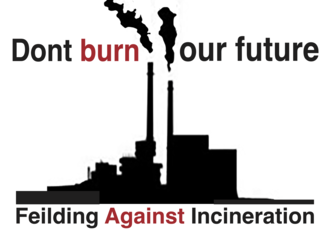 Feilding Against Incineration - Don’t Burn Our Future!We urge Horizons Regional Council to decline the discharge to air resource consent application lodged by Bio Plant Manawatū to build a waste-to-energy pyrolysis facility in Feilding, Aotearoa New Zealand. Failing that, we urge the Manawatū District Council to call an urgent public forum on the issue fully disclosing the environmental, social, economic and cultural impacts. We request that: 1. That the Horizons Regional Council publicly notify the discharge to air resource consent application lodged by Bio Plant Manawatū so that Feilding and the wider community have the opportunity for input. This is required under section 95A of the Resource Management Act 1991 as the adverse environmental effects are likely to be 'more than minor'. 2. Horizons Regional Council requires that the consenting process extends beyond emissions to air to also include discharge to land and water - because we know that toxicants will be produced in the processes being described by Bio Plant Manawatū and potentially released into our waterways and soils. 3. Horizons Regional Council identifies the lack of alignment of the resource consent application with their One plan policy, 3-8, 3-9 and 3-10 on waste management. 4. Manawatū District Council identifies the lack of alignment with their Waste Management and Minimisation Plan, and statutory responsibilities outlined in their Environmental Stocktake. 5. Horizons Regional Council and the Manawatū District Council obtain a public health expert assessment of the proposed pyrolysis plant before it is given consent to proceed.731 of 800 SignaturesCreated by Feilding Against
 -
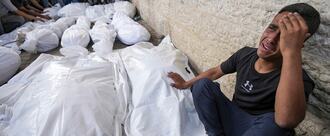 Israel Sanction Act: Delay Means Palestinians PayIn January 2024, the International Court of Justice (ICJ) ordered a series of provisional measures against Israel[1]. Some of these measures include ordering Israel to; 1. Take all possible measures to prevent genocidal acts. 2. Take effective measures to enable the provision of urgently needed basic services and humanitarian assistance to the Gaza Strip. 3. Prevent the destruction of evidence related to allegations of acts. Israel has failed to comply with the ICJ's provisional measures and, in some areas, committed more violations after the ruling[2]. NZ must impose economic and diplomatic sanctions on Israel in response to the violations of the ICJ provisional measures, similar to those placed on Russia in the 2022 Russia Sanctions Act. NZ created the act three weeks into Russia's invasion of Ukraine and has since imposed sanctions on over 1,600 people and entities, including Vladimir Putin and his inner circle, following Russia's invasion of Ukraine two years ago till February 2024. Regarding Israel, NZ has only placed sanctions in the form of travel bans on individual extremist settlers in the West Bank. However, these sanctions have little to no effect as the number of settler attacks on Palestinians and their property has increased. Sanctioning a few settlers will not help, while NZ turns a blind eye to ministers who arm and incite settlers to carry out attacks, e.g. Minster Ben Gvir, Bezalel Smotorich and Benjamin Netanyahu. The Russia Sanction Act is a framework that can be easily copied and was purposed for responding to wars, severe human rights abuses, and emergency situations. NZ can sanction Israel by creating an "Israel Sanction Act". NZ's inability to do so thus far has highlighted its double standards when responding to war crimes and violations of international law. The Israel Sanction Act could be tied to Israel's ability to meet its obligated provisional measures and prevent further Israeli impunity. For example, sanctions could be lifted if Israel meets the following: 1. Open all available land crossings to humanitarian aid trucks. - The only two available crossings are the Rafah and Kerem Shalom crossings[4]. Israel must open the Erez crossing to Palestinians in the north who are currently facing Israel-induced famine. 2. Guarantee the safety of all civilians, aid seekers, and coordinators of humanitarian aid. - Israel requires the coordination of all movements of UN and aid agency personnel within Gaza. Despite coordination of aid, according to Human Rights Monitor, the Israeli military has killed at least 560 and injured 1,523 other Palestinians in incidents involving aid trucks amid it's war on Gaza from October 7 - to March 23[5]. The casualty tolls comprise Palestinian aid seekers, aid workers, and coordinators and distributors. 3. To not deliberately obstruct lifesaving humanitarian assistance during a man-made famine. - As of the 25th of March, Israel has intentionally blocked all UNRWA aid deliveries to northern Gaza, which, as mentioned earlier, 70% of the northern population is in a state of man-made famine[6]. UNRWA is the largest provider of humanitarian aid in Gaza, serving at least 1.7 million Palestinians in Gaza[7]. Intentionally blocking aid from a UN organisation that has a legal right to provide aid in Gaza, particularly during a famine, is a clear war crime[8]. 4. To remove the repetitive bureaucratic procedures designed to slow aid delivery. - There was a 44% reduction in aid delivery during February compared to January[4]. The main blockers of aid entry are arbitrary denials by Israel and lengthy clearance procedures, which include repetitive screenings during narrow operating hours. Aid trucks, on average, wait 20 days during the screening process to be cleared to enter Gaza[4]. Trucks yet to be screened end up stranded in extensive queues[9]. -The screening process is also inconsistent, as trucks can pass one inspection only to be rejected in the second inspection despite having no change. Entire caravans are either arbitrarily rejected or due to items considered of "dual use"[10]. The dual-use list has arbitrary inclusions such as anesthetics, crutches, dates, fuel generators and oxygen tanks[11]. 5. To not pursue ground and ariel operations in Rafah - Rafah is the last “safe zone” for more than 1.5 million Palestinians. Palestinians have been repeatedly displaced in Gaza because Israel's actions contradict their statements[12]. Areas previously declared as "safe zones" are not safe at all. There is nowhere else for the Palestinians to go[13]. 6. To not build illegal settlements and confiscate Palestinian land in the West Bank - On the 23rd of March, Israel announced their illegal seizure of 800 hectares of land in the occupied West Bank (Palestinian territory)[14]. This is also the largest land appropriation in over 30 years. Israel also plans to build 3500 illegal settlements in the West Bank[15]. Settlements, which involve the forced transfer of the local/indigenous population, are illegal in international law[16].996 of 1,000 SignaturesCreated by Abdul Safi
 -
 Say NO to More Pokies for Sky City Casino HamiltonWe want the Gambling Commission to decline Sky City Casinos application for additional gambling machines on the basis of; • Public sentiment • Current council policy • Harms to society • Comparatively tiny returns to the community This petition aims to send a clear message to the Gambling Commission, Sky City Casinos Limited and our elected representatives on the Hamilton City Council that the residents of Hamilton do not want and do not support Sky City Casino's request to the Gambling Commission for additional pokie machines.224 of 300 SignaturesCreated by Deborah Fisher
 -
 Stop the 2017 Weapons Expo!We say no to the annual NZDIA conference (Weapons Expo) being held in Wellington. We demand that the Wellington City Council and Greater Wellington Regional Council do not allow any part of this city to be used to support or enable the weapons expo to occur.1,117 of 2,000 SignaturesCreated by Peace Action Wellington
 -
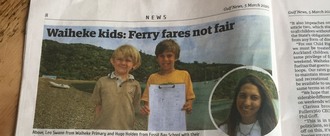.jpg) Include the Waiheke Ferry Service in Auckland Transport's 'Free Child Weekend Fares'The children of Waiheke Island are asking for you to include us in the Mayor of Auckland’s ‘Free travel for children in the weekend’ initiative. Whilst we appreciate that the bus service on the island is free during the weekend, we would like the free travel extended to the ferry services. As you are aware the only mode of transport for us to get off the island is ferry.486 of 500 SignaturesCreated by Clarissa Mackay
Include the Waiheke Ferry Service in Auckland Transport's 'Free Child Weekend Fares'The children of Waiheke Island are asking for you to include us in the Mayor of Auckland’s ‘Free travel for children in the weekend’ initiative. Whilst we appreciate that the bus service on the island is free during the weekend, we would like the free travel extended to the ferry services. As you are aware the only mode of transport for us to get off the island is ferry.486 of 500 SignaturesCreated by Clarissa Mackay -
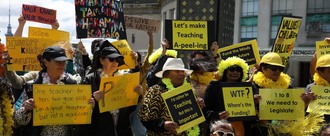 Stand with early childhood teachers to save pay parityWe call on Prime Minister Chris Luxon, Hon David Seymour, Hon Erica Stanford, and all government MPs to: VALUE: Keep pay parity to show you value early childhood teachers and their skills in educating and supporting our youngest tamariki to grow and learn PROTECT: Protect our mokopuna by ensuring they get safe, high quality early learning from expert, qualified teachers RESPECT: Invest in creating the best conditions for teachers educating and supporting our youngest tamariki – teachers’ working conditions are children’s learning conditions11,628 of 15,000 SignaturesCreated by NZEI Te Riu Roa
 -
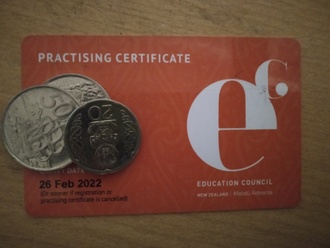 The Teaching Council must be reviewedWe the undersigned call for the Ministry of Education to review the Teaching Council. A full review of the Teaching Council must address its functions, its responsibilities to teachers and its spending. The outcome of the review must guarantee the Council serves teachers' best interests.11,078 of 15,000 SignaturesCreated by Anna Hamilton