100 signatures reached
To: The incoming New Zealand Government, particularly the ministers responsible for consumer protection and privacy, with support from the Minister of Justice.
Stop the sale of smart glasses until privacy and safety safeguards are in place
Everyone in Aotearoa deserves to be able to take part in public life and go about their everyday lives, without being secretly filmed.
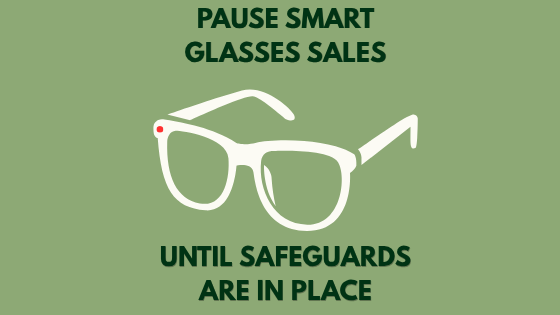
We call on the next New Zealand Government to introduce an immediate pause on the sale of consumer smart glasses until effective, enforceable privacy and safety safeguards are in place.
Before sales resume, the Government should establish a regulatory framework that:
- Requires manufacturers, importers and technology companies to assess and reduce foreseeable risks of covert recording, surveillance and technology-facilitated abuse before products reach the market.
- Sets enforceable standards for recording indicators, recording and livestreaming capabilities, and the collection, storage, retention and sharing of recorded information.
- Requires clear disclosure about how captured information is processed, who can access it and whether it is used to train AI systems.
- Reviews whether existing New Zealand laws adequately protect people from covert recording for sexual or exploitative purposes, including when someone is clothed or recorded in a public place.
The framework should include appropriate protections for legitimate assistive uses, particularly for disabled people who rely on smart glasses to access information or navigate their surroundings.
Companies should have to demonstrate that they have addressed foreseeable risks before these products are made widely available. People should not be left to bear the consequences of risks that manufacturers and technology companies could have anticipated.
Smart glasses are already in Aotearoa - with no privacy safeguards in place
Smart glasses look like ordinary eyewear, but many models contain cameras and microphones. Some can livestream what the wearer sees or use AI to interpret what it records and sees.
These devices create new opportunities for secret recording. Someone can film the people around them without visibly holding up a phone. The person being recorded may never notice the small indicator light, and may have no idea that footage of them exists.
New Zealand's Privacy Commissioner has raised concerns about smart glasses being used to film and livestream women without their consent. He has also called for the legal rules covering these devices to be reviewed, including whether manufacturers and technology vendors should have stronger privacy-by-design obligations.
Why is this important?
Women and girls are already being secretly filmed, including in Aotearoa
Smart glasses are entering a world where women and girls already experience voyeurism, sexual harassment and image-based abuse. The technology can make these forms of abuse easier to carry out discreetly.
Overseas, men have used Ray-Ban Meta glasses to record encounters with women in public and post the footage on social media. Women have reported being filmed during everyday interactions, with videos attracting sexualised comments from strangers. Women working in massage parlours and the sex industry have also reportedly been filmed without their knowledge. In the United States, reports have described boys secretly filming girls with smart glasses and uploading footage to TikTok.
There has already been a case in New Zealand. An Auckland man used Ray-Ban Meta glasses in an attempt to make an intimate visual recording of a sex worker without her consent. The case resulted in a guilty plea to attempting to make an intimate visual recording. It demonstrates how easily a device designed for everyday use can also be used to violate someone's privacy.
The consequences can continue long after a recording is made. Footage can be uploaded, copied and shared beyond the control of the person recorded. An ordinary interaction can be presented to an online audience as entertainment, with the woman at its centre having no say in how she is shown.
Children and young people face serious risks too. They should be able to attend school, socialise and spend time in public without having to wonder whether someone nearby is secretly recording them.
NZ law does not clearly protect people from being secretly filmed in public
New Zealand law can address some forms of harmful recording. The Crimes Act 1961 criminalises certain intimate visual recordings made without consent, and the Harmful Digital Communications Act 2015 can apply to the distribution of intimate recordings and other harmful digital communications.
However, these protections have limits. Many reported incidents involving smart glasses concern fully clothed women filmed in public. A recording of that kind may fall outside the legal definition of an intimate visual recording, even if the footage is captured for sexual reasons and later used to humiliate or harass the person recorded. Other legal avenues may depend on the circumstances or require proof that is difficult to establish.
Classification laws can prohibit material involving the sexual exploitation of children when it meets the legal test for an “objectionable” publication. But that test does not cover every harmful use of smart glasses. Livestreaming, AI alteration or sharing of footage can cause serious harm without the resulting material being legally “objectionable” under the Act. This means some harmful uses of smart glasses may fall outside the protection.
The Privacy Commissioner has acknowledged the need to examine whether the current framework adequately addresses the risks. That review should include the responsibilities of companies that design, import and sell these products.
Companies must take responsibility for harm that is easy to predict
When companies introduce a new technology, they make choices about its design and what it can do. Those choices affect how easily the product can be misused and what happens to the information it captures.
A small recording light, for example, offers limited protection if people nearby cannot see it or do not know what it means. Companies should not be able to shift responsibility for foreseeable harms onto customers by simply telling them to use a product responsibly.
We have seen this pattern across the technology sector. Products are released and widely adopted, then the public is left to deal with the harms while the laws that protect us struggle to catch up. Women and girls are often expected to change their behaviour and remain alert to new forms of abuse. The companies profiting from the technology face far less pressure to prevent that abuse before it occurs.
Recent events show why we cannot rely on individual retailers to make the right call. Kmart has now removed its Anko camera glasses from sale in New Zealand and Australia, amid growing privacy concerns. But more expensive camera-enabled glasses, including Ray-Ban Meta and Oakley Meta, remain available in Aotearoa through other retailers. A retailer’s decision to withdraw one product is welcome, but it is no substitute for enforceable safeguards that protect everyone, regardless of which brand is being sold.
Smart glasses offer an opportunity to change that approach. Companies should be required to assess foreseeable risks before products reach the market and build effective safeguards into their design. That should include meaningful recording notifications and strict controls over how footage is stored, accessed and used by AI systems.
Smart glasses also raise tikanga and Māori data sovereignty concerns
Smart glasses raise particular issues in contexts such as tangihanga and other culturally significant gatherings, where recording may conflict with tikanga relating to tapu, noa, whakapapa and the appropriate handling of images and voices. A device worn on the face cannot recognise or respect these contexts, and the person wearing it may not understand the tikanga involved. The ability to record, identify and store Māori faces and voices also raises concerns about Māori data sovereignty, particularly where biometric information is collected or processed without Māori control.
A pause now lets us set the rules before covert filming becomes the norm
Smart glasses can provide genuine benefits. For blind and low-vision people, AI-enabled glasses can help read signs, identify objects and navigate unfamiliar places. Regulation should protect those uses and access, including through appropriate exceptions or pathways for assistive technology.
A pause on consumer sales would give New Zealand time to establish clear rules before these products become more popular. It would also send a clear message that companies must account for foreseeable harm when developing and selling powerful new technologies.
The next Government has an opportunity to act on the concerns already raised by the Privacy Commissioner. We should not wait until covert recording becomes an ordinary part of public life, or until more people discover that footage of them has been shared without their consent.