
500 signatures reached
To: Government, the House of Representatives
Recognise that Economic Abuse is Family Violence
.png)
We are calling on Ministers, Members of Parliament, and Government officials to recognise financial control, ruined credit, withheld payments and coerced loans and debt as forms of family violence, and to improve our laws and systems that entrap victim-survivors and perpetuate the harm caused by these forms of family violence.
Why is this important?
We see the impact of economic abuse and family violence in our day-to-day work. We support victim-survivors and try to mitigate the harm caused by people who perpetrate economic abuse. But we often fight losing battles, because New Zealand’s systems allow economic abuse to happen, all too often with no recourse for addressing the harm caused.
Economic abuse is a form of family violence that uses coercive, controlling, and threatening behaviour to restrict or remove a person’s financial freedom, autonomy, and security. It is experienced in close personal relationships, particularly intimate partner relationships, and often occurs alongside other family violence behaviours. Research shows that 15% of ever-partnered women have experienced economic abuse. [1]
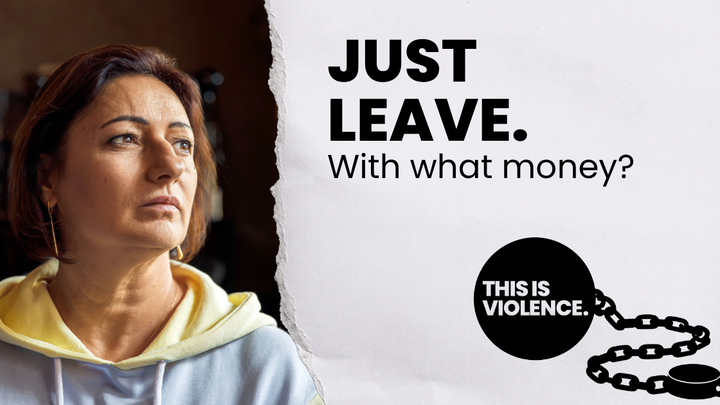
Despite the prevalence of economic abuse, it is rarely recognised and responded to as a form of family violence. Yet the impact can be devastating. Without access to money, victim-survivors lack resources to escape violent partners and remain independent. We estimate it costs around $10,000 to separate from an abusive partner [2]. Even if they can escape, when faced with the threat of poverty, women may choose to stay.
When victim-survivors are able to leave, many are forced to carry coerced debt, ruined credit and financial harm long after the relationship ends. This is violence. We need to stop treating it like a hardship or budgeting problem.
New Zealand laws and systems that don’t acknowledge and respond to this form of abuse adequately are lagging behind other countries. The United Kingdom and Australia have focused on amending legislation, policies, and processes to better support victim-survivors of economic abuse over the last five to ten years [3]. In contrast, Te Aorerekura and its associated Action Plans to date have no mention of, or response to, economic abuse [4]. Economic abuse is a form of family violence under the Family Violence Act 2018, but this only applies to the granting of a protection order (and ancillary property or furniture order) [5].
Economic abuse is not an isolated issue; it is a long-term driver of gender inequality and intergenerational harm in Aotearoa and needs to be treated as such.
Policy recommendations have been developed in close partnership with the National Collective of Independent Women’s Refuges, and are endorsed by around 80 other organisations from across the family violence, financial, and gender equity sectors. For the full list of policy changes recommended, see our website at https://thisisviolence.co.nz
References:
1. Economic Abuse by An Intimate Partner and Its Associations with Women’s Socioeconomic Status and Mental Health, by Brooklyn M. Mellar, Janet Lynn Fanslow, Pauline J. Gulliver, and Tracey K. D. McIntosh.
Economic abuse is not an isolated issue; it is a long-term driver of gender inequality and intergenerational harm in Aotearoa and needs to be treated as such.
Policy recommendations have been developed in close partnership with the National Collective of Independent Women’s Refuges, and are endorsed by around 80 other organisations from across the family violence, financial, and gender equity sectors. For the full list of policy changes recommended, see our website at https://thisisviolence.co.nz
References:
1. Economic Abuse by An Intimate Partner and Its Associations with Women’s Socioeconomic Status and Mental Health, by Brooklyn M. Mellar, Janet Lynn Fanslow, Pauline J. Gulliver, and Tracey K. D. McIntosh.
Economic Abuse by An Intimate Partner and Its Associations with Women’s Socioeconomic Status and Mental Health - Brooklyn M. Mellar, Janet Lynn Fanslow, Pauline J. Gulliver, Tracey K. D. McIntosh, 2024
2. Financial barriers to exiting abusive relationships, by Good Shepherd NZ
2. Financial barriers to exiting abusive relationships, by Good Shepherd NZ
Report: Financial barriers to exiting abusive relationships - Good Shepherd NZ
3. For example: Family Violence Flexible Support Packages. Family Violence Flexible Support Packages | vic.gov.au
4. Te Aorerekura Action Plan 2025-2030, Breaking the Cycle of Violence. The Centre for Family Violence and Sexual Violence Prevention.
3. For example: Family Violence Flexible Support Packages. Family Violence Flexible Support Packages | vic.gov.au
4. Te Aorerekura Action Plan 2025-2030, Breaking the Cycle of Violence. The Centre for Family Violence and Sexual Violence Prevention.
Breaking the Cycle of Violence | The Centre for Family Violence and Sexual Violence Prevention
5. See Family Violence Act 2018, 11(e). Family Violence Act 2018 | New Zealand Legislation
5. See Family Violence Act 2018, 11(e). Family Violence Act 2018 | New Zealand Legislation