
 Union Network of Migrants (UNEMIG)
1,000 signatures reached
To: All Leaders and Immigration Spokespersons of all political parties represented in Parliament, and to all party candidates standing for election
Migrants are not disposable workers
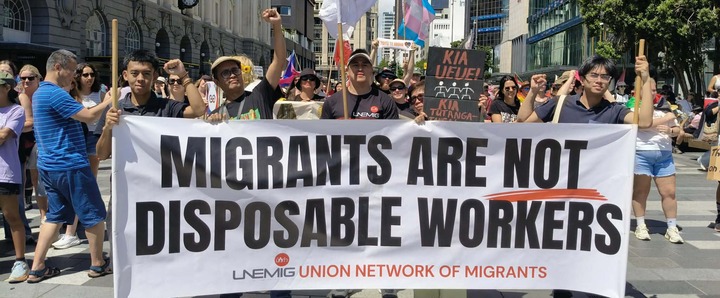
We call on every political party in Aotearoa New Zealand to commit, in their immigration policy, to act with urgency and humanity by:
- Ending Tied Visas
Decouple work visas from single employers. Migrant workers must have the right to change jobs freely to escape exploitation, creating a fairer labour market for all. - Suspending the 12-Month Stand-Down Period
Scrap this cruel and counterproductive rule. It creates a massive risk of exploitation as migrants scramble to find any way to remain, while simultaneously harming family wellbeing and stripping our industries of the experienced workers they need. - Implementing Reasonable English Language Requirements
Replace rigid, one-size-fits-all English testing with flexible, reasonable and role-appropriate language standards.
Why is this important?
Aotearoa New Zealand should be a country where everyone can thrive and workers are respected and treated fairly. But right now migrant communities are left vulnerable by the profound power imbalance of our immigration system leaving them unprotected from exploitation.
"Every person in New Zealand, regardless of their visa status, deserves the right to safe work, decent pay, dignity and the freedom to speak up without the threat of deportation hanging over them. When your ability to stay in the country is controlled by your employer, raising concerns about safety or wage theft becomes a risky choice. This system is designed to silence people, leaving them isolated and at great risk of abuse."
— Mandeep Bela, President, Union Network of Migrants (UNEMIG)
The 12-month stand-down period compounds this injustice by creating conditions that can destabilise families and increase migrants’ vulnerability. While some families may leave Aotearoa together when a visa ends, there are real situations where separation becomes unavoidable—particularly when one partner is able to secure employment and transition to a new visa, such as an Accredited Employer Work Visa (AEWV), but cannot meet the requirements to support their dependents. At the same time, for those on capped or lower-skilled visa pathways, the pressure to avoid the stand-down period can drive migrants into precarious or informal arrangements with employers, increasing the risk of exploitation or agreements made solely to extend their stay. Rather than providing stability, the stand-down period reinforces uncertainty, undermines family unity, and places already vulnerable workers in situations where their rights and wellbeing may be compromised.
This lack of fairness extends to rigid and overly high English testing standards, which often do not reflect a person's proven ability to communicate in day-to-day conversation to work, contribute, and integrate. When a migrant is already employed and performing their role safely and effectively — as a bus driver, for example, demanding they pass an academic English test for a further visa makes no sense. Fairness demands reasonable, role-appropriate requirements, not one-size-fits-all barriers. Previous Work-to-Residence (WTR) settings proved that a worker's experience should be sufficient proof of competency, allowing for employer letters to confirm English proficiency.
This lack of fairness extends to rigid and overly high English testing standards, which often do not reflect a person's proven ability to communicate in day-to-day conversation to work, contribute, and integrate. When a migrant is already employed and performing their role safely and effectively — as a bus driver, for example, demanding they pass an academic English test for a further visa makes no sense. Fairness demands reasonable, role-appropriate requirements, not one-size-fits-all barriers. Previous Work-to-Residence (WTR) settings proved that a worker's experience should be sufficient proof of competency, allowing for employer letters to confirm English proficiency.
VOICES FROM THE COMMUNITY:
On Tied Visas: “My boss knew I couldn’t leave. He charged me a premium for a job offer and paid me half of what was in my employment agreement. I felt completely powerless. I had to choose between speaking up and losing my visa or staying silent and watching my savings disappear while living in financial and emotional hardship. I felt invisible, like my dreams and my dignity didn't matter.”
— Mary (name changed for protection), former hospitality worker
On the Stand-Down Period: “We arrived with nothing but hope. For three years, we worked from dawn till dusk, saved every dollar, and our daughter, who was born here, is now 2 years old. My employer wants to keep me on, but AEWV conditions state that I must leave the country for a year after my visa ends. We live in constant anxiety about being torn away from the life we’ve built. Our hearts are breaking.”
— Maria and Michael (names changed), migrant workers
On English Language Requirements: “I have been driving buses in New Zealand for around 3 years. I know the routes, keep passengers safe, communicate with my depot and with passengers every single day. My employer has no issues with my work and performance and wants to keep me. But Immigration New Zealand requirements are that I must achieve an unreasonably high academic English test score which is very difficult for many migrants. It feels like a trap, not a fair requirement.”
— Raj (name changed for protection), bus driver currently working in New Zealand on a temporary visa
CONCLUSION
"We have an opportunity to build an immigration system rooted in fairness and respect. By ending punitive policies and adopting reasonable standards, we can ensure New Zealand truly values the people who contribute their labour, their talents, and their lives to our country. Political parties must now show where they stand."
— Mandeep Bela, President, Union Network of Migrants (UNEMIG)
We, the undersigned, call on all political parties to adopt these three asks in their immigration policies:
Union Network of Migrants (UNEMIG)
International Migrants Alliance (IMA) Aotearoa
Migrante Aotearoa
Migrant Action Trust
Gabriela Aotearoa
Soil of Cultures
Anakbayan Aotearoa
Union Network of Migrants (UNEMIG)
International Migrants Alliance (IMA) Aotearoa
Migrante Aotearoa
Migrant Action Trust
Gabriela Aotearoa
Soil of Cultures
Anakbayan Aotearoa
United Filipino Bus Drivers in New Zealand
Filipino Careworkers United
Migrant Rights Network NZ
Banyuhay Aotearoa
Migrant Workers Association
Asians Supporting Tino Rangatiratanga
Banyuhay Aotearoa
Migrant Workers Association
Asians Supporting Tino Rangatiratanga